
IAS 12 governs the accounting treatment of income taxes. The objective of the standard is to ensure the proper recognition of current and deferred taxes, as well as the tax consequences of transactions and events.
IAS 12 – Income Taxes
IAS 12 governs the accounting treatment of income taxes.
IAS 12 at a Glance
What does IAS 12 cover?
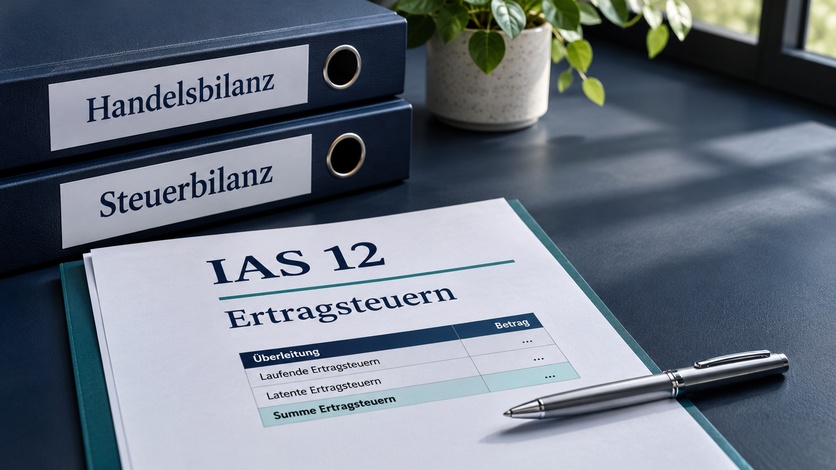
Objective of IAS 12
IAS 12 governs the accounting treatment of income taxes. The objective of the standard is to ensure the proper recognition of current and deferred taxes, as well as the tax consequences of transactions and events.
The standard is based on the principle that the tax consequences of assets and liabilities are recognized at the same time as their recognition in the financial statements.
Key Definitions
Tax Base
The value of an asset or liability for tax purposes. [IAS 12.5]
Temporary Differences
Differences between the carrying amount of an asset or liability and its tax base. [IAS 12.5]
Taxable temporary differences
Differences that will result in taxable amounts in the future. [IAS 12.5]
Deductible temporary differences
Differences that will result in tax-deductible amounts in the future. [IAS 12.5]
Deferred Tax Liabilities
Income taxes payable in the future arising from taxable temporary differences. [IAS 12.5]
Deferred Tax Assets
Future tax benefits arising from deductible temporary differences, tax loss carryforwards, or tax credits. [IAS 12.5]
Current Tax
Current tax liabilities shall be recognized in the amount of taxes not yet paid. Overpayments are reported as a tax asset. [IAS 12.12]
Tax loss carrybacks that result in a refund of taxes already paid shall be recognized as an asset. [IAS 12.13]
Measurement is based on the tax rates and tax laws in effect or virtually enacted as of the balance sheet date. [IAS 12.46]
Calculation of Deferred Taxes
Deferred taxes arise from temporary differences between IFRS carrying amounts and tax bases.
The basic calculation formulas are as follows:
Temporary difference = Carrying amount – Tax base
Deferred tax = Temporary difference × Tax rate
For tax loss carryforwards, the following applies:
Deferred tax asset = Tax loss carryforward × Tax rate
Tax Bases
The tax basis is determined in accordance with applicable tax regulations and the expected realization or settlement of the asset or liability.
Key Provisions:
- For assets, the tax basis generally corresponds to the amount that will be tax-deductible in the future. [IAS 12.7]
- For deferred expenses or advance payments received, the tax basis is reduced by amounts that will not be subject to tax in the future. [IAS 12.8]
- Items not recognized on the balance sheet may also have tax bases. [IAS 12.9]
- In consolidated financial statements, the carrying amounts in the consolidated financial statements are decisive. [IAS 12.11]
Examples
- For property, plant, and equipment, the tax basis generally corresponds to the unused tax depreciation.
- Receivables often have the same tax basis as their carrying amount.
- Goodwill that is not tax-deductible generally has a tax basis of zero.
- For advance payments received, the tax basis depends on when taxation occurs.
Recognition of Deferred Taxes
Deferred Tax Liabilities
In general, deferred tax liabilities must be recognized for all taxable temporary differences. [IAS 12.15]
Exceptions apply in particular to:
- goodwill recognized for the first time [IAS 12.15(a)]
- certain initial recognitions outside of business combinations [IAS 12.15(b)]
- temporary differences arising from investments, provided that their reversal can be controlled and is not expected in the near term. [IAS 12.39]
Deferred Tax Assets
Deferred tax assets are recognized only if it is probable that sufficient taxable income will be available in the future to utilize the deductible differences or tax loss carryforwards. [IAS 12.24, IAS 12.34]
The recoverability of deferred tax assets must be assessed at each reporting date. Amounts that can no longer be utilized must be written down; subsequent write-ups are possible. [IAS 12.37]
Measurement of Deferred Taxes
Deferred tax assets and deferred tax liabilities are measured using the expected tax rates in effect at the time of realization or settlement. [IAS 12.47]
The measurement takes into account the expected manner of use or disposal of an asset or the settlement of a liability. [IAS 12.51]
Special provisions apply, among other things, to:
- revalued non-depreciable assets [IAS 12.51B]
- investment property as defined in IAS 40 [IAS 12.51C–D]
- distribution-dependent tax rates [IAS 12.52A]
Discounting deferred taxes is not permitted. [IAS 12.53]
Recognition of Tax Expenses
The tax expense for a period consists of:
Tax expense = Current tax + ΔDeferred taxes
Tax effects are generally recognized in the same line item where the underlying transaction is recognized. [IAS 12.58]
Therefore, recognition occurs:
- in net income for the period,
- in other comprehensive income (OCI), or
- directly in equity,
depending on where the underlying transaction was recognized. [IAS 12.61A]
Tax effects arising from business combinations regularly affect the calculation of goodwill under IFRS 3. [IAS 12.66]
Presentation in the Financial Statements
Offsetting actual tax assets and tax liabilities is permitted only if there is a legally enforceable right to offset and an intention to settle on a net basis. [IAS 12.71]
Additional requirements apply to deferred taxes, in particular the same tax jurisdiction and identical taxable entities. [IAS 12.74]
Tax expense or tax income must be presented separately in the income statement. [IAS 12.77]
Disclosures in the Notes
IAS 12 requires extensive disclosures regarding current and deferred taxes. These include, in particular:
- Breakdown of tax expense [IAS 12.79]
- Reconciliation between expected and actual tax expense [IAS 12.81]
- Changes in tax rates
- Disclosures regarding temporary differences, tax loss carryforwards, and tax credits
- Tax effects in other comprehensive income and equity
- Disclosures regarding deferred taxes arising from investments
- Tax consequences of dividends paid after the balance sheet date
- Disclosures regarding the tax effects of business combinations.
In addition, IAS 1 requires separate disclosure of current and deferred tax items on the balance sheet, as well as tax expense in the statement of comprehensive income.
Diese Übersicht dient der sachlichen Orientierung und ersetzt keine Rechts- oder Bilanzierungsberatung im Einzelfall. Rechtsstand: 2026
Related Standards
Related Topics on the Wiki
IAS 12 refers to other standards in several places. These are relevant for classification.
Frequently Asked Questions
Questions About IAS 12
Deferred taxes arise from temporary differences between the IFRS carrying amount and the tax basis: Deferred tax = Temporary difference × Tax rate.
Only if it is probable that sufficient taxable profits will be available in the future to utilize the deductible differences or loss carryforwards. [IAS 12.24, IAS 12.34]
No, under IAS 12, it is not permissible to discount deferred taxes. [IAS 12.53]
Consulting
Do you have questions about implementing IAS 12 in your consolidation process?
Deferred taxes are among the most complex items in consolidated financial statements. We can help you implement IAS 12 in a practical manner within your tax reporting and consolidation solution.
About BLUEBIRD
BLUEBIRD is an independent consultancy for Corporate Performance Management. Our consultants combine IFRS expertise with implementation in CCH Tagetik, OneStream, Oracle or other solutions – from software selection to ongoing operations.
- More than 20 years of experience in consolidation, planning and reporting
- Vendor-independent
- Awarded TOP CONSULTANT 2025
- Offices in Zurich, Munich, Vienna and Amsterdam
Contact Form
Your question regarding IAS 12
Please briefly describe your request. We will get back to you within two business days.