Skip to content

Oracle TRCS: Structured Management of Tax Reporting and Tax Provisions

Integrate tax calculations, provisions, and reporting into a single data source.

Classification

Integrate Tax Reporting and Tax Provision More Closely with Finance

Tax calculations, provisions, and tax disclosures in financial statements draw directly on financial data from accounting and consolidation. If these processes are managed using separate files and manual intermediate steps, the effort required for reconciliation between Tax, Finance, and Group Reporting increases.

Oracle TRCS brings tax and financial data together on a single platform. This allows tax calculations, tax provisions, and reporting to be mapped within a unified process.

WHAT IS ORACLE TRCS

Oracle TRCS in the EPM Network

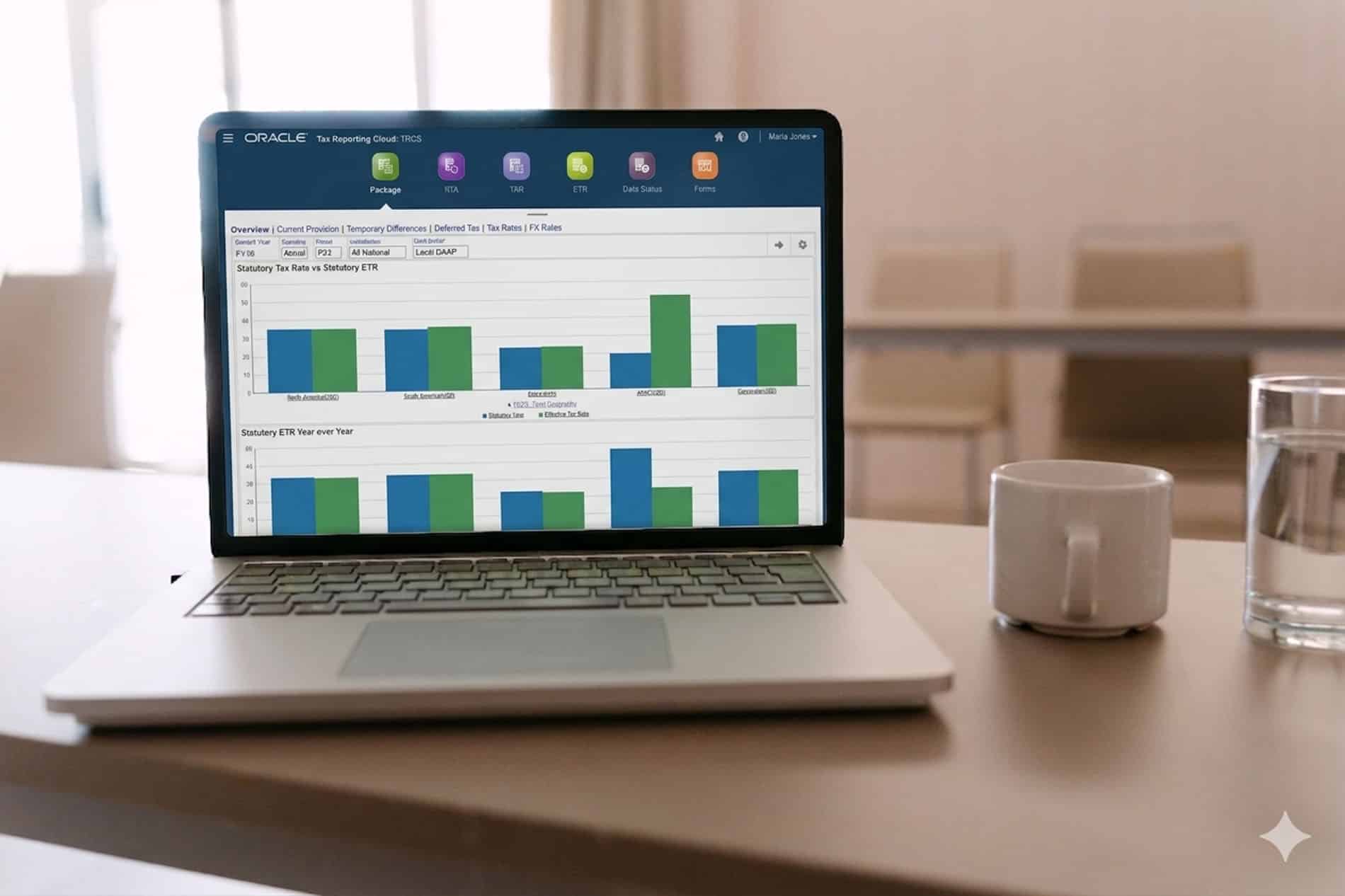
Oracle TRCS (Tax Reporting Cloud Service) is part of the Oracle EPM Cloud and supports tax provisioning, tax reporting, tax accruals, and other tax-related financial closing processes.

Within the Oracle EPM landscape, TRCS complements Planning, FCCS, and Narrative Reporting, among others, with tax calculation and reporting functions.

Within the Oracle EPM landscape, TRCS fulfills a clearly defined role:

  • Planning supports planning and forecasting
  • FCCS focuses on group consolidation and financial close
  • Narrative Reporting manages report-oriented approval and publication processes
  • TRCS addresses tax provisions, tax reporting, and tax closing processes

Thus, from a functional perspective, TRCS lies between the financial data foundation, tax calculation logic, and group reporting.


bb-trcs-section2-finance-dashboard

BACKGROUND

When Tax Closing Processes Become a Reconciliation Burden

Tax provisioning and tax reporting rely on data from accounting, consolidation, and other financial systems. If calculations, provisions, and financial statement disclosures are maintained in separate files and processes, this leads to additional reconciliations and inconsistent data.

Typical challenges include:

MANUAL PROCESSES

Excel-based or decentralized processes for tax provisions and tax accruals.

TRANSPARENCY

Limited transparency regarding calculation logic, assumptions, and approvals.

VOTE

Significant coordination effort between Tax, Finance, Accounting, and Group Reporting.

DATABASE

Heterogeneous data sources without a consistent tax data foundation.

REGULATORY FRAMEWORK

Increasing requirements stemming from IFRS, U.S. GAAP, and regulatory reporting obligations.

TRACEABILITY

Limited traceability in tax valuations and financial statement disclosures.
FEATURES

What Oracle TRCS Does in the Context of Finance and Tax

Oracle TRCS provides a structured approach to the tax closing process—from data collection through calculation and validation to reporting—and integrates tax requirements into existing finance, consolidation, and reporting processes.

bb-trcs-section3-finance-dashboard
Data Collection & Validation

Structured collection and validation of tax-related data from finance and tax sources.

Current and Deferred Taxes

Calculation of current and deferred taxes within a consistent process framework.

Tax Provisions & Reserves
Presentation of tax provisions at the consolidated and company levels.
Effective Tax Rate
Transparent reconciliation of the effective tax rate.
Standardized Workflows
Structured workflow for the tax closing process, including approvals.
Reliable Analyses
Reports for closing, analysis, and reporting.

Core Areas

Integrated mapping of tax logic, provisions, and reporting

Oracle TRCS consolidates key requirements for tax reporting into a single platform architecture.

bb-trcs-section4-finance-dashboard-2

Tax Provision / Tax Calculation

  • Calculation of Current and Deferred Taxes
  • Recognition of Tax Provisions at the Company and Consolidated Levels
  • Recognition of deferred tax assets and liabilities
  • Consistent and transparent tax logic
Oracle_TRCS_3

Effective Tax Rate and Tax Analyses

  • Reconciliation of the Effective Tax Rate
  • Tax Analyses at the Group and Company Levels
  • Comprehensible analyses for financial statements and reporting
  • Transparency regarding the impact of taxes on earnings
bb-trcs-section4-finance-dashboard

Integration into Financial Statement Preparation and Reporting Processes

  • Integration of Tax and Financial Data on a Common Platform
  • Support for tax disclosures and post-closing analyses
  • Integration into consolidation, reporting, and governance processes
  • Reduced data silos between tax, finance, and corporate reporting

This is how tax processes are calculated, reviewed, analyzed, and consistently incorporated into the financial statements.

Added Value

The Value Oracle TRCS Delivers

With Oracle TRCS, companies improve the efficiency of their tax closing processes and, above all, the quality, transparency, and interoperability of their tax and finance processes.

Current Situation

With Oracle TRCS

Manual, decentralized tax commission processes
Standardized and repeatable process logic
Reconciliation Efforts Between Tax, Finance, and Group Reporting
Greater transparency and a shared database
Inconsistent Tax Provisions and Tax Reserves
More Consistent Tax Provisions and More Robust Reserves
Limited Traceability of Tax Calculations
Greater transparency in calculations and financial statements
Isolated tax system logic
Integrated integration with Oracle EPM (Consolidation, Reporting, Governance)
Uncertainty in International Reporting Structures
Greater Process Reliability in International Reporting and Financial Statement Structures
TARGET AUDIENCES

For Which Companies Is Oracle TRCS Particularly Relevant?

Oracle TRCS is particularly well-suited for companies that want to standardize their tax closing processes and systematically enhance collaboration between the tax and finance departments. In practice, this applies in particular to:

  • International corporations with complex tax reporting requirements

  • Companies with IFRS or US-GAAP reporting

  • Organizations with significant reconciliation efforts between tax, accounting, and corporate reporting

  • Companies that want to map tax provisions and tax provision processes more consistently

  • Oracle EPM environments where tax processes need to be more tightly integrated


Particularly relevant for:

  • Tax functions and tax reporting teams

  • Group Accounting and Consolidated Financial Reporting

  • Finance functions reporting directly to the CFO

  • Finance and tax transformation teams

bluebird-oracle-trcs-tax-reporting-workshop-participants

SUITABILITY AND LIMITATIONS

Where the Limits of Oracle TRCS Lie

TRCS delivers added value in situations where tax-related closing logic, standardization, transparency, and close integration with finance and reporting processes are all required.

TRCS is typically less suitable for:

  • for simple tax requirements without a structured tax provision process

  • when tax closing processes are only minimally formalized from an organizational standpoint

  • when neither integration with consolidation and reporting nor robust governance requirements are a priority

  • when the module cannot be meaningfully integrated into the existing finance, tax, and data landscape


When evaluating TRCS, process maturity, system architecture, and organizational responsibilities are just as important as the scope of functionality.

Frequently Asked Questions

Questions Frequently Asked by Finance and Tax Professionals

The duration depends on the scope, data environment, and degree of integration. Pure tax provision implementations with a manageable group scope typically take between four and six months. International rollouts involving multiple jurisdictions, parallel reporting under IFRS and U.S. GAAP, and integration with existing FCCS or ERP systems tend to take eight to twelve months. Specific timeframes can only be reliably estimated after a scoping phase.

A typical TRCS scoping process takes two to three weeks. We review the existing tax and finance landscape, consult with Tax, Group Accounting, and IT, and analyze tax provision logic, data sources, and reporting requirements. The result is an assessment of whether TRCS is a good fit from a technical standpoint, how it should be integrated into the existing EPM architecture, and which implementation options are realistic—including an indication of effort and risk.

As part of the Oracle EPM Cloud, TRCS is designed to integrate with FCCS—financial data from consolidation can be used as the basis for tax provisions and the effective tax rate. For ERP systems (Oracle Fusion, SAP, Microsoft Dynamics, etc.), the connection is typically established via Data Integration (EDMCS / Data Management) or dedicated integration layers. The specific architecture depends on the existing system landscape and data quality.

TRCS makes sense when there is a structured tax provision process in place or one is to be established, when the tax closing logic can be formalized, and when tax, accounting, and corporate reporting are clearly assigned within the organization. From a technical standpoint, a robust data foundation is helpful—although improving data quality is often a key part of the TRCS project itself. Existing use of Oracle EPM is not a requirement, but it is a common catalyst.

TRCS is one of several established tax provision and tax reporting solutions on the market. Its particular strength lies in its tight integration with the Oracle EPM Cloud—if FCCS, Planning, or Narrative Reporting are already in use or planned for implementation, TRCS is the natural architectural choice. For companies using a different EPM platform or those without an Oracle connection, alternative solutions may be a better fit. We evaluate this independently of the technology as part of our platform selection process.

For key users in Tax and Group Accounting, initial training typically lasts two to five days, depending on the role and level of detail. End users in decentralized tax functions usually require significantly less training—here, the focus is on data entry, approvals, and reporting. We support the go-live with hypercare phases and recommend structured documentation of the tax provision logic so that system knowledge is not tied to individual employees.

CONSULTING APPROACH

Why BLUEBIRD Is the Right Consulting Partner

BLUEBIRD combines in-depth financial expertise with experience in Oracle EPM, consolidation, planning, reporting, and related financial processes.

We support companies from the business design phase through data modeling and implementation to integration into existing ERP and EPM landscapes.

In doing so, we always consider Oracle within the context of the respective process requirements, system architecture, and existing finance structures.

For you, this means:

  • Integration of TRCS into your tax and finance architecture rather than an isolated software implementation

  • Integration of business and IT perspectives in conceptualization, process design, and implementation

  • Independent consulting tailored to your actual tax, reporting, and governance requirements

  • Experience in the integration of Oracle EPM, ERP, data integration, and corporate processes

  • A focus on sustainable process and target models rather than purely technical implementation


This results in solutions that are robust from a business perspective, technologically compatible, and operationally effective.

bluebird-oracle-trcs-tax-reporting-consulting-workshop

How We Work

How We Work

Our project work is shaped through direct collaboration between finance experts, architects, and implementation teams—online, on-site, and in focused workshop formats.

bluebird-oracle-trcs-finance-consulting-workshop
bluebird-oracle-trcs-workshop-tax-reporting-team_1
bluebird-oracle-trcs-finance-team-consultation-meeting

NEXT STEP

Organize Your Tax Financial Statements

In 45 minutes, we’ll show you how Oracle TRCS consistently maps tax provisions, deferred taxes, and consolidated tax reporting.

Contact

Experts in Oracle TRCS and Tax Reporting

Your contacts for scoping, platform assessment, and implementation.

Roger-Ernst_Bluebird-ag_800x800

Roger Ernst

Partners
florian-schloegl-bluebird

Florian Schlögl

Sales Director