Skip to content

Oracle EDMCS: Centralized Management of Master Data and Hierarchies

Centrally manage master data, hierarchies, and metadata, and implement changes in a controlled manner across systems.

Classification

Maintaining Consistent Structures Across Systems

Accounts, cost centers, companies, and other corporate structures are often maintained in multiple applications. This results in differing hierarchies, manual reconciliations, and uncertainty about the impact a change will have on downstream systems.

Oracle EDMCS supports the centralized management and governance of master data, reference data, and metadata. Changes are requested, validated, and approved before being applied to the respective application views. BLUEBIRD provides support for the business design, integration, and implementation.

WHAT IS ORACLE EDMCS

Oracle EDMCS in the EPM Network

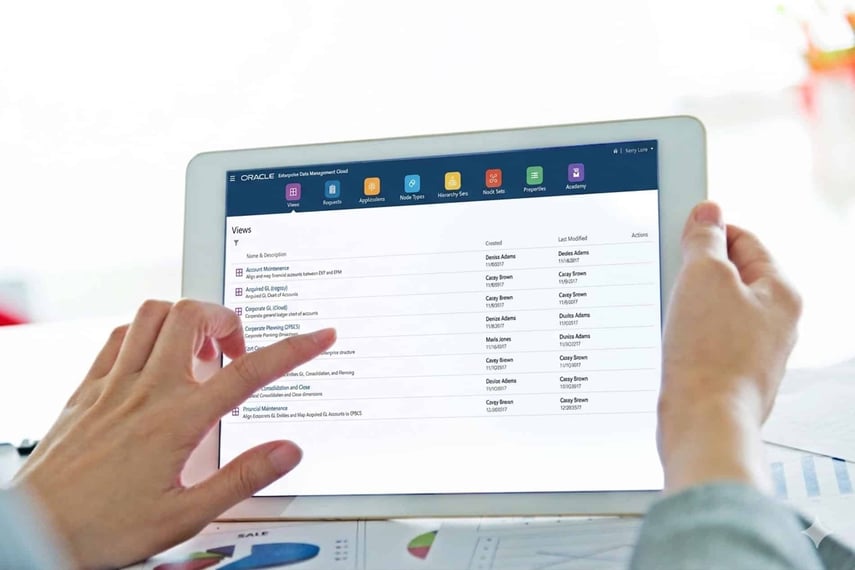
Oracle EDMCS stands for Enterprise Data Management Cloud Service. The module is part of the Oracle EPM Cloud and helps companies manage master data, hierarchies, dimensions, mappings, and application-specific metadata in a centralized and controlled environment.

EDMCS is not a standalone system, but rather a specialized Oracle EPM module for metadata governance, hierarchy management, and controlled change processes. It becomes relevant wherever structural enterprise data must be kept consistent across multiple applications, changes must be implemented in a traceable manner, and different business perspectives must be reconciled with one another.

Within the Oracle EPM landscape, EDMCS plays a clearly defined role:

  • Planning uses dimensions, hierarchies, and planning structures for forecasting and control
  • FCCS requires consistent organizational, account, and equity structures for consolidation and close
  • Narrative Reporting benefits from coordinated structures for reporting-oriented processes and disclosure
  • EDMCS centrally manages master data, hierarchies, and metadata across applications and business units

Thus, from a functional perspective, EDMCS bridges the gap between data governance, structure management, application integration, and reporting architecture.

Oracle_EDMCS_1

STARTING POINT

When Structures Vary Across Systems

Accounts, cost centers, organizational units, product structures, and legal entity hierarchies are maintained across multiple applications in complex system landscapes. Differing structures and versions complicate consolidation, reporting, planning, and governance.

Distributed Care

Different master data and hierarchy structures across multiple applications.

Manual Synchronization

Significant effort is required for changes, coordination, and synchronization.

Unclear Effects

Lack of transparency regarding the impact of planned structural changes.

Inconsistent Views

Business outlooks for reporting, planning, and management vary.

Incomplete documentation

Limited traceability of change decisions and approvals.

Reorganization & M&A

Increasing demands resulting from cloud migrations, M&A, and governance.
Features

What Oracle EDMCS Does in the Context of Finance and Data

Oracle EDMCS helps companies centrally manage structural business data and implement changes in a controlled manner across applications. This includes master data, reference data, hierarchies, dimensions, mappings, and alternative business perspectives.

In the context of finance and data, this means:
  • Centralized control of structures instead of distributed maintenance in individual systems
  • Controlled change processes with validation, approval, and traceability
  • Harmonization of different perspectives across applications and business units
  • Greater consistency for planning, consolidation, reporting, and analysis
  • Greater transparency regarding the effects of structural changes

This transforms decentralized metadata maintenance into a structured governance process for enterprise-wide data and hierarchy management.

Oracle_EDMCS_2
CORE AREAS

Control the Further Development of Master Data and Hierarchies

Oracle EDMCS manages structured enterprise data using a process-oriented, cross-application approach.

Centralized Management of Structures

  • Centrally manage charts of accounts, cost centers, organizational structures, product categories, and legal entity hierarchies
  • Maintain dimensions, attributes, and mappings consistently without having to replicate the same change across multiple applications

Controlled Change Processes

  • Record and validate changes based on requirements, and review them from a technical perspective before implementing them in production
  • Visualize planned impacts, document approvals, and maintain a traceable history of changes

Harmonization Between Perspectives and Applications

  • Compare different perspectives on hierarchies and align them in a targeted manner
  • Quickly identify discrepancies in nodes, relationships, or attributes
  • Apply changes to downstream applications and synchronize them automatically via interfaces

In this way, structural data is not only maintained, but also monitored, harmonized, and further developed in accordance with governance requirements.

Added Value

The Added Value Oracle EDMCS Provides

With Oracle EDMCS, companies not only improve the quality of their master data management but, above all, the consistency, transparency, and controllability of their structural business data.

Current Situation

With Oracle EDMCS

Master data is maintained in a distributed manner across each system
Centralized Governance for Master Data, Hierarchies, and Metadata
Data quality depends on manual diligence
Higher data quality through validation, approvals, and controlled change processes
Weeks of Coordination for Structural Changes
Less coordination effort between departments and applications
Reorganization as a Major Construction Project
Faster implementation of structural changes during reorganizations, migrations, or M&A
Effects Will Only Be Visible After Going Live
Greater transparency regarding the impact of planned changes
Audit Questions Without a Clear Lead
Improved auditability through traceable audit trails and change histories
TARGET AUDIENCES

For Which Companies Is Oracle EDMCS Relevant?

Oracle EDMCS is particularly well-suited for companies that want to manage master data, hierarchies, and metadata consistently and in a controlled manner across multiple applications.

Oracle EDMCS is particularly well-suited for:

  • Corporate groups and larger midsize companies with established system landscapes
  • Companies with multiple finance, reporting, and planning applications
  • Organizations that need to manage cloud migrations, reorganizations, or structural changes resulting from M&A
  • Companies that want to further harmonize their finance, consolidation, and reporting structures
  • Organizations with heightened requirements for governance, auditability, and data quality

EDMCS is particularly relevant for:
  • Group Accounting and Consolidated Financial Reporting
  • Controlling and finance transformation
  • Master data and data governance managers
  • Architecture and reporting functions closely tied to the CFO
bluebird-oracle-edmcs-consulting-meeting-data-governance

SUITABILITY AND LIMITATIONS

Where the Limits of Oracle EDMCS Lie

Oracle EDMCS is not the most suitable solution in every context. Oracle EDMCS demonstrates its value when multiple applications use the same or related business structures and changes must be coordinated in a controlled manner.

EDMCS is typically less suitable:

  • in very simple system landscapes with little need for cross-system metadata control

  • when hierarchies and master data are maintained in only a few applications without significant governance requirements

  • when no clear organizational roles, approvals, or responsibilities for structural changes are to be established

  • when the module cannot be meaningfully integrated into the existing data, EPM, and application architecture

Frequently Asked Questions

Questions Frequently Asked by Group Accounting and Data Governance Managers

It is realistic to expect that the first productive EDMCS application with a clearly defined data scope (e.g., chart of accounts, cost center structure) can be implemented in 4–6 months. If multiple applications, business perspectives, and interfaces are involved, this becomes an iterative, multi-phase program.

We’ll start by asking about the pain points: Which structural changes are the most time-consuming today, where do inconsistencies arise, and which applications are affected? This will lead to the definition of the data scope, a governance model, and a proposal for a phased rollout.

EDMCS offers pre-built adapters for the EPM modules as well as generic interfaces for ERP and other target systems. What matters is not the technical integration, but rather which application remains the primary one and where EDMCS takes control.

A willingness to clearly define responsibilities for structural changes in a binding manner, as well as a shared understanding of which application serves which perspective. Without this clarification, EDMCS will be technically implemented but will not be effective from an organizational standpoint.

EDMCS specializes in structural enterprise data—hierarchies, dimensions, mappings—and is deeply rooted in the EPM environment. Traditional MDM tools often have a broader data scope (customers, suppliers, materials). In many architectures, both worlds coexist in a division of labor.

During the design and modeling phase, business units are closely involved—hierarchical logic, validation rules, and approval workflows must be defined collaboratively. Once the system is in operation, the effort required per change decreases significantly because the impact of changes becomes apparent before they are implemented.

CONSULTING APPROACH

Why BLUEBIRD Is the Right Consulting Partner

BLUEBIRD combines financial expertise, a deep understanding of consolidation, Oracle EPM experience, and architectural expertise. This ensures that TRCS is not only implemented technically but also integrated into your tax, finance, and reporting processes from a business perspective.

For you, this means:

  • Integration of TRCS into your tax and finance architecture rather than an isolated software implementation

  • Integration of business and IT perspectives in concept development, process design, and implementation

  • Independent consulting tailored to your actual tax, reporting, and governance requirements

  • Experience in the integration of Oracle EPM, ERP, data integration, and corporate processes

  • A focus on sustainable process and target models rather than purely technical implementation


This results in solutions that are robust from a business perspective, technologically compatible, and operationally effective.

Bluebird Offsite Plenum 80
CONSULTING APPROACH

Why BLUEBIRD Is the Right Consulting Partner

BLUEBIRD combines in-depth financial expertise with experience in Oracle EPM, consolidation, planning, reporting, and related financial processes.

We support companies from the business design phase through data modeling and implementation to integration into existing ERP and EPM landscapes.

In doing so, we always consider Oracle within the context of the respective process requirements, system architecture, and existing finance structures.

For you, this means:

  • Integrating EDMCS into your target architecture rather than implementing it as an isolated tool

  • Integration of business and IT perspectives in governance, process design, and implementation

  • Independent consulting tailored to your requirements for master data, hierarchies, and reporting structures

  • Experience in the integration of Oracle EPM, ERP, data integration, and finance processes

  • A focus on robust data and governance models rather than purely technical implementation


This results in solutions that are robust from a business perspective, technologically compatible, and operationally effective.

bluebird-oracle-edmcs-team-office-loft
CONSULTING APPROACH

Why BLUEBIRD Is the Right Consulting Partner

BLUEBIRD combines financial expertise, a deep understanding of consolidation, Oracle EPM experience, and architectural expertise. This ensures that TRCS is not only implemented technically but also integrated into your tax, finance, and reporting processes from a business perspective.

For you, this means:

  • Integration of TRCS into your tax and finance architecture rather than an isolated software implementation

  • Integration of business and IT perspectives in concept development, process design, and implementation

  • Independent consulting tailored to your actual tax, reporting, and governance requirements

  • Experience in the integration of Oracle EPM, ERP, data integration, and corporate processes

  • A focus on sustainable process and target models rather than purely technical implementation

This results in solutions that are robust from a business perspective, technologically compatible, and operationally effective.

Bluebird Offsite Plenum 80

How We Work

How We Work

In workshops with Finance, Data Governance, and IT, we map out structures, responsibilities, and change processes. Based on this, we develop the information model, the governance workflows, and the integration into the existing system landscape.

bluebird-oracle-edmcs-workshop-data-governance-participants
bluebird-oracle-edmcs-implementation-consulting
bluebird-oracle-edmcs-metadata-workshop-analysis

NEXT STEP

Organize Your Master Data and Metadata Governance

Let BLUEBIRD help you organize your application perspectives, change processes, and integration requirements.

Contact

Experts in Oracle EDMCS and Data Governance

Your contacts for scoping, governance design, integration, and implementation.

Roger-Ernst_Bluebird-ag_800x800

Roger Ernst

Partners
florian-schloegl-bluebird

Florian Schlögl

Sales Director