
IAS 16 governs the accounting treatment of property, plant, and equipment. The standard specifically addresses the recognition, measurement, depreciation, and impairment of property, plant, and equipment.
IAS 16 – Property, Plant, and Equipment
Recognition, Measurement, Depreciation, and Impairment of Property, Plant, and Equipment (PPE) under IFRS.
IAS 16 at a Glance
What does IAS 16 cover?
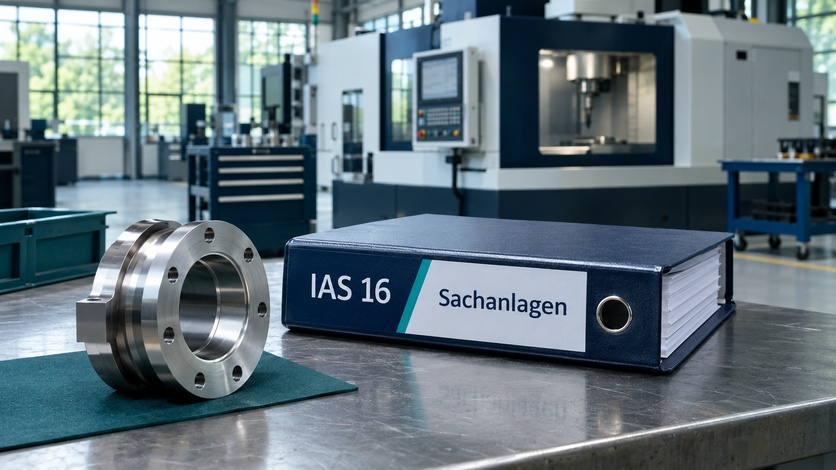
Objective
IAS 16 governs the accounting treatment of property, plant, and equipment. The standard addresses, in particular, the recognition, measurement, depreciation, and impairment of property, plant, and equipment.
Scope
IAS 16 applies to property, plant, and equipment, unless another standard prescribes a different accounting treatment. Excluded, in particular, are:
- assets held for sale in accordance with IFRS 5,
- biological assets under IAS 41,
- exploration and evaluation assets under IFRS 6, and
- mineral resources such as oil or gas reserves. [IAS 16.3]
However, the Standard applies to property, plant, and equipment used to develop or utilize these assets. [IAS 16.3]
In addition, IAS 16 applies to so-called “bearer plants,” but not to the agricultural produce of these plants. [IAS 16.3]
Recognition of Property, Plant, and Equipment
Property, plant, and equipment shall be recognized as an asset if: [IAS 16.7]
- future economic benefits are probable and
- the cost of acquisition or construction can be measured reliably.
These criteria apply both to the initial acquisition or construction and to subsequent expenditures, such as expansions, replacement parts, or major maintenance.
IAS 16 does not define a fixed unit of measurement for property, plant, and equipment. [IAS 16.9] However, significant components of an asset must be depreciated separately if their cost is material in relation to the total asset. [IAS 16.43]
Costs for components that are replaced on a regular basis or for major inspections are capitalized provided the recognition criteria are met. At the same time, the carrying amount of the replaced component must be written off. [IAS 16.13–14]
Initial Measurement
Property, plant, and equipment must be measured at cost upon initial recognition. [IAS 16.15]
Cost includes all directly attributable expenses necessary to bring the asset to a condition ready for use. These include, in particular: [IAS 16.16–17]
- Purchase price,
- transportation and installation costs,
- site preparation,
- fees for architects or engineers,
- estimated dismantling and restoration costs.
Proceeds from the sale of goods generated during production or commissioning are not deducted from the cost of acquisition or production but are recognized in income. [IAS 16.20A]
For long-term payment terms, an interest component must be taken into account. [IAS 16.23]
If the acquisition is made in exchange for another asset, the asset is generally measured at fair value, provided that the exchange has economic substance and the fair value can be reliably determined. [IAS 16.24]
Subsequent Measurement
IAS 16 permits two measurement models:
Cost Model
The asset is recognized at cost less accumulated depreciation and impairment losses. [IAS 16.30]
Revaluation Model
The asset is recognized at its revalued amount, i.e., its fair value at the date of revaluation, less subsequent depreciation and impairment losses. This requires a reliable determination of fair value. [IAS 16.31]
Revaluations must be performed regularly to ensure that the carrying amount does not deviate materially from fair value. [IAS 16.31]
If an asset is revalued, the entire asset class must be revalued. [IAS 16.36]
Treatment of Revaluations
If the value of an asset increases as a result of a revaluation, the increase in value is recognized in other comprehensive income (OCI) and reported in the revaluation reserve within equity. [IAS 16.39]
To the extent that prior write-downs of the same asset were recognized in profit or loss, the revaluation gain is initially recognized in profit or loss. [IAS 16.39]
Impairments resulting from revaluations are recognized in profit or loss to the extent that no corresponding revaluation reserve exists. [IAS 16.40]
Upon the disposal of a revalued asset, the revaluation reserve may be transferred directly to retained earnings; recognition through the income statement is not permitted. [IAS 16.41]
Depreciation
Depreciation is calculated systematically over the asset’s useful life. The basis is the depreciable amount:
Depreciable amount = Cost – Residual value
The depreciation method must reflect the expected consumption of economic benefits. [IAS 16.60]
Revenue-based depreciation methods are not permitted. [IAS 16.62A]
Residual value, useful life, and depreciation method must be reviewed at least annually. Changes are treated prospectively as changes in estimates in accordance with IAS 8. [IAS 16.51, IAS 16.61]
Depreciation begins as soon as the asset is ready for use and continues until the asset is derecognized, even if the asset is temporarily not in use. [IAS 16.55]
Depreciation is generally recognized in profit or loss, unless it becomes part of another asset. [IAS 16.48]
Impairment
Property, plant, and equipment must not be carried at an amount higher than its recoverable amount. IAS 16 refers to the impairment provisions in this regard.
The recoverable amount is the higher of:
- fair value less costs to sell, or
- value in use.
Compensation from third parties for impairment losses or damages is recognized in income as soon as the right to compensation arises. [IAS 16.65]
Derecognition
Property, plant, and equipment shall be derecognized when:
- they are disposed of, or
- no future economic benefits are expected. [IAS 16.67]
Gains or losses on disposal result from the difference between the proceeds from the sale and the carrying amount and are recognized in income. [IAS 16.68–71]
Assets that were previously leased and are now held for sale are reclassified to inventory at their carrying amount. [IAS 16.68A]
Disclosures in the Notes
For each class of property, plant, and equipment, the following, among other items, must be disclosed: [IAS 16.73]
- Measurement method,
- depreciation methods,
- useful lives or depreciation rates,
- Gross carrying amounts,
- accumulated depreciation and impairment losses,
- reconciliation of carrying amounts.
In addition, disclosures are required regarding: [IAS 16.74]
- Collateral and restrictions on disposal,
- capitalization commitments,
- capitalized production costs,
- compensation to third parties.
Additional Disclosures for Revaluation
If property, plant, and equipment are accounted for using the revaluation model, the following must also be disclosed: [IAS 16.77]
- Date of revaluation,
- Involvement of external appraisers,
- Carrying amounts under the historical cost model,
- Changes in the revaluation reserve, including distribution restrictions.
Diese Übersicht dient der sachlichen Orientierung und ersetzt keine Rechts- oder Bilanzierungsberatung im Einzelfall. Rechtsstand: 2026
Related Standards
Related Topics on the Wiki
Frequently Asked Questions
FAQ
Under the historical cost model, the asset is recognized at amortized cost. Under the revaluation model, the asset is recognized at fair value, provided that fair value can be reliably determined.
No. IAS 16 expressly excludes revenue-based depreciation methods. [IAS 16.62A]
When it is disposed of or when no future economic benefits are expected from it. [IAS 16.67]
Consulting
Do you have questions about implementing IAS 16 in your consolidation process?
The accurate reporting of property, plant, and equipment is a key component of a sound consolidated balance sheet. We support you in the practical implementation of IAS 16 in your consolidation solution.
About BLUEBIRD
BLUEBIRD is an independent consultancy for Corporate Performance Management. Our consultants combine IFRS expertise with implementation in CCH Tagetik, OneStream, Oracle or other solutions – from software selection to ongoing operations.
- More than 20 years of experience in consolidation, planning and reporting
- Vendor-independent
- Awarded TOP CONSULTANT 2025
- Offices in Zurich, Munich, Vienna and Amsterdam
Contact Form
Your question regarding IAS 16
Please briefly describe your request. We will get back to you within two business days.